 Tone-policing men’s pain is a cultural silencing tactic. One that serves to keeps male victims invisible and female perpetrators unaccountable. Supporting male victims isn’t evidence of misogyny. It shows that you have basic human decency.
There are very few taboo topics left in modern society. Norms have all but been eroded. People shamelessly broadcast their traumas, dramas, and thirst traps across every platform imaginable for Likes, sympathy, cash, clout, revenge, or just to control the narrative.
But you know what still gets people clutching their pearls?
Acknowledging that men experience abuse.
Or worse than that, pointing out that some women are abusive.
Even now in 2025, stating that men are just as likely to be abuse victims as women is met with eye-rolls, derision, anger, and outright denial.
And if you dare to call out a woman for being controlling, manipulative, or emotionally abusive?
Well, you’re still labeled a misogynist just as I was back in 2009 when I began Shrink4Men.
Case in point: a few weeks ago, I shared a meme on my social media channels about , which is pretty standard fare for me.
Preemptive Compliance: How Men Adapt to Survive in Abusive Relationships
Turns out this was a controversial post for some people:
Ever notice how you started disappearing from your own life before she even asked you to?
A lot of men don’t wait to be told “you’re selfish” or “you care more about your friends than me.”
They already know the storm is coming, so they give up their hobbies, friends, gym time, pets, even family before the first guilt trip lands.
Not because they want to.
Not because they’re weak.
But because—usually starting with mom or dad—they learned:
Resistance = punishment.
Being your true self = loss of love.
So they comply in advance.This is what emotional abuse often looks like for men.
It doesn’t always scream.
It doesn’t always hit.
Sometimes, it just wears you down until you disappear piece by piece and call it “compromise” or “happy wife, happy life.”It’s healthy to have hobbies.
It’s healthy to have friends.
It’s healthy to stay close to your family and the things that make you you.The problem was never your board game night buds, your softball team, or your bond with your sister.
The problem is disappearing to keep the peace.
The problem is people-pleasing until there’s nothing left of you to please.Reclaiming your time, your passions, and your identity isn’t selfish, it’s how you heal.
And if your wife or girlfriend finds that threatening?
Ask yourself what she’s ever truly sacrificed for you.Hint: “Sacrificing” a job or career she never wanted so she could stay home and be financially supported by you doesn’t count.
That’s not martyrdom. That’s entitlement.

It also hits home for women demanding this behavior from their partners. Then it becomes a mirror, and guess what?
They don’t like the reflection, because it names abusive female behavior without sugarcoating or making excuses for it.
This shouldn’t be a controversial post. Except that it is.
A woman who follows Shrink4Men shared the meme to her Facebook community group with the disclaimer:
This doesn’t apply to every woman or every man.
Obviously, my meme doesn’t apply to every woman and every man. That should go without saying. But that’s not the reality of the polarized culture wars world we live in.
Even with the , the Tone-Police descended—armed with self-righteous moralizing and concern trolling.
Calling Officer Karen. Officer Karen, do you copy? Tone-policing of men’s pain in progress. All available units report to the scene of the Thought Crime.
Funny how naming female-perpetrated abuse typically causes more outrage than the abuse itself.
Some of these women may have recognized their own behavior in the post. Or maybe they just didn’t like seeing the behavior of toxic women in plain-speak.
Either way, their discomfort wasn’t about the delivery. It was about breaking a pet taboo: describing men’s experience of female perpetrated abuse without reducing it to a footnote to female abuse victims.
Going by the comments, I clearly touched a nerve. Or rather, several nerves.
What can I say? Sacred cows make the best hamburger.
What followed is a textbook example of how the issue of male abuse victims are met in public discourse:
-
Defensiveness
-
Ideological filtering
-
Misrepresentation
-
Diminishing the credibility of my arguments based on style, not accuracy
Their reactions show why tone-policing men’s pain remains a problem. These aren’t just internet quirks. They’re common tactics used to silence male victims online and offline.
If you’ve had your experiences dismissed this way, you’re not imagining it.
Now let’s break down what happened comment-by-comment.
Tone-Policing Men’s Pain Tactic #1: Call Anyone Raising the Issue of Male Abuse Victims and Female Perpetrators a Misogynist
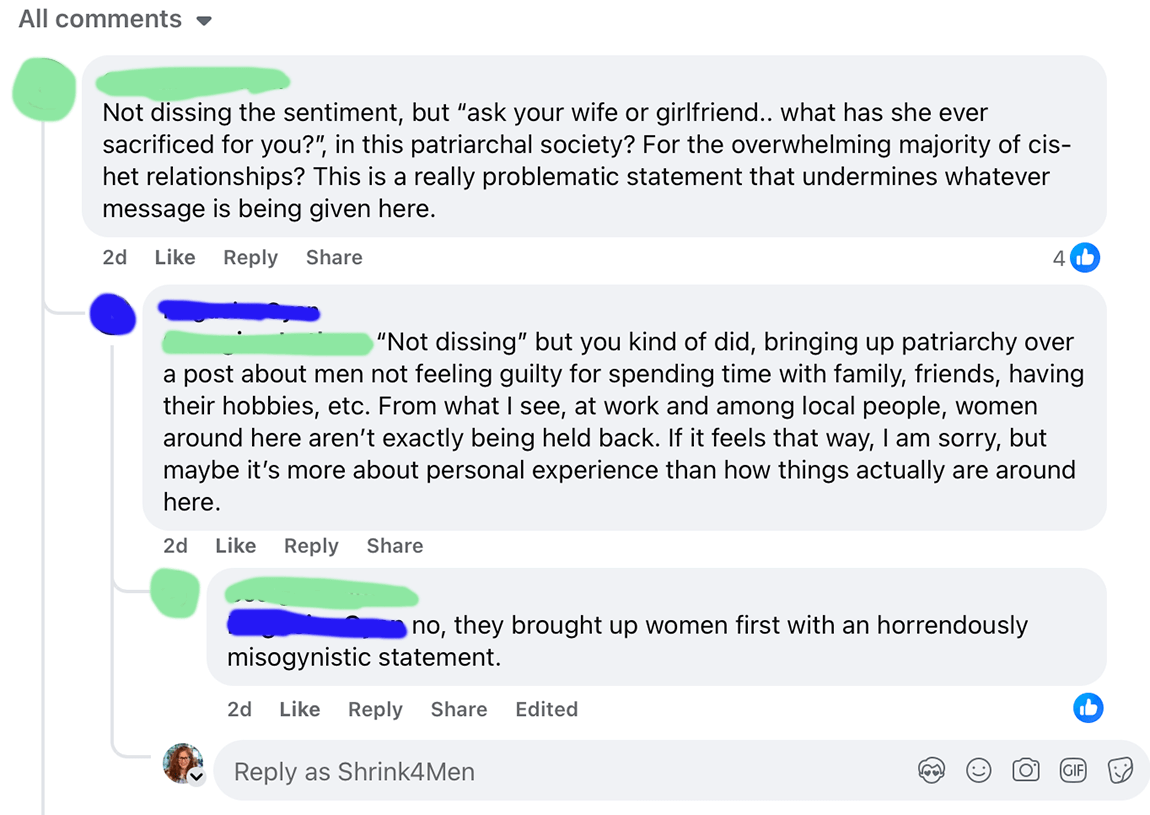
But what about the Patriarchy?!
Green Lady comments:
Not dissing the sentiment, but ‘ask your wife or girlfriend… what has she ever sacrificed for you?’ In this patriarchal society? For the overwhelming majority of cis-het relationships? This is a really problematic statement that undermines whatever message is being given here.
What just happened? Yes, she’s tone-policing men’s pain, but what else?
Green Lady derails the focus on male emotional abuse by making it about patriarchal oppression and framing the post as inherently misogynistic. She doesn’t engage the core trauma-informed message. She turns it into a gender war. As if describing how men appeasing abusive partners somehow erases Women’s Struggles.
This is reflexive feminist framing 101:
Any focus on male suffering is immediately suspect unless it centers, or serves, female victimhood.
Blue Man pushes back politely:
‘Not dissing,’ but you kind of did, bringing up patriarchy over a post about men not feeling guilty for spending time with family, friends, hobbies, etc. From what I see, women around here aren’t exactly being held back. If it feels that way, I’m sorry, but maybe it’s more about personal experience than how things actually are around here.
Undeterred, Green Lady doubles down:
No, they brought up women first with a horrendously misogynistic statement.
And just like that, the conversation ends.
Blue Man doesn’t reply. Maybe he felt silenced. Or maybe he’s smart enough to walk away from the Internet equivalent of playing chess with a pigeon.
No matter what you do, it’s still gonna strut around, knock over the pieces, and shit all over the board.
Basically, Green Lady thinks I’m a Misogynistic Tool of The Patriarchy™.
Would you believe it’s not the first time I’ve been accused of that because I have compassion for male abuse victims and men in general?
I know, I know.
I’m a horrendously mysogynistickal monster.
Tone-Policing Men’s Pain Tactic #2:
Deflect and derail with non-existent attacks on moms.
 Magenta Lady has entered the chat:
I also have to say that bottom bit sounds like a dig at motherhood. If we’d like, we can get into how low the bar is set for men that they essentially get a round of applause for being a dad every time they ‘watch’ their own kids.
I’m sorry, but although I appreciate the sentiment of the post, I find it too controversial and feel like it’s not really doing the men any favours in my opinion.
Ah yes, the defense.
This isn’t about equality; it’s about narrative control.
My clients could be cooking, cleaning, doing school pickups, bedtime routines, and still get told they’re “not doing it right” and need to “do more.” They’re not supposed to expect appreciation either—just silent compliance.
as a coping mechanism in relationships with toxic women.
Deflect, Derail, and Redirect
Rather than engaging the kind of emotional abuse many men suffer, Magenta Lady derails the conversation into a tired narrative about stay-at-home moms and unequal parenting standards.
It’s empathy redirection and empathy suppression. A reflexive attempt to downgrade male pain and elevate female grievance as the only valid form of suffering.
Because if anyone acknowledges that men are suffering, too, someone needs to remind Facebook that women are the most victim-y and most suffer-y of them all.
As a reminder, my meme isn’t about who “watches” the kids. It’s about appeasing narcissistic and borderline women to keep the peace.
Tone-Policing Men’s Pain Tactic #3: Discrediting the Source When You Can’t Refute the Content
When Male Victims Speak Up, the Tone-Police Show Up

Yellow Lady
I’ve had a little look into ‘Shrink4Men.’
Everything they publish has an ‘us vs. them’ message. Reputable support systems for those who are experiencing abuse do not take on this dangerous narrative.
It’s well known that victims can and do become abusers, and this weirdly aggressive form of ‘take back what you deserve’ is quietly encouraging tables to turn.
Most support networks advocate for victims to disengage from their abusers (with whatever support they need), not to engage with it.
Men do require a different narrative and approach to encourage them to seek support. At best, this is a fumbled attempt at that; at worst, it is inciting retaliation.
I don’t believe it has a place on a community page.
Equally, if this was reversed ‘women victims vs. male abusers or indeed non-gendered, I would also be saying the exact same thing. Reputable support systems do not take on this narrative.
Translation:
I scanned a few headlines, felt uncomfortable, and now I’m going to tone-police and platform-shame instead of engaging the content.
This is also an example of tone-policing men’s pain via a legitimacy attack:
-
Dismiss the message by questioning the speaker’s language use.
-
Undermine the entire platform by branding it “dangerous” for not using feminist-approved victim language and issuing Not-All-Women-Are-Like-That disclaimers every third sentence. I also failed to acknowledge that Women-Are-Victims-Too! every other sentence. Whoopsy-doodle!
Unless male pain is expressed in approval-seeking hushed tones with multiple , it’s deemed a threat.
Notice how quickly Yellow Lady’s concern shifts from “fumbled attempt” to “dangerous incitement” all because a man might consider setting a boundary with his wife.
The horror, the horror.
To clarify:
My Complying in Advance post isn’t about retaliation.
It’s about self-reclamation and healing.
It’s about men waking up and saying, “I’m allowed to have boundaries. I don’t have to sacrifice my well-being to please my partner. Because if she really loved me, she wouldn’t demand that of me.”
So you understand, this is basic psycho-education on most trauma-informed female-centered narcissistic abuse survivor communities that they all “Yass, Queen!” to like clapping seals.
Can I get a “Yass, King!”? Anyone?
Apparently not.
What Yellow Lady really means is: “You can be a male victim, but only if you do so in a way I approve of, and that doesn’t make me and other women feel bad.”
Yeah. That doesn’t work for me, Yellow Lady.
Tone-Policing Men’s Pain Tactic #4: Yes, Male Victims Need Support, But Not Like That

Next, Red Lady piles on with some affirmative applause:
Well said! 👏 I also looked at their page and felt really uncomfortable with the combative tone.
Support for victims, and recognizing that anyone can be a victim, is really important.
This isn’t the way to do it.
Again, this one doesn’t disagree with what I’m saying. She just doesn’t like the way I’m saying it.
Blunt. Real. Unflinching.
And, if I do say so myself, with a certain joie de cheekiness.
There’s zero direct engagement with the content. No argument, no counterpoint, no curiosity.
Just more tone-policing of men’s pain.
And a vague appeal for a more palatable, neutered, feminist appeasing kind of advocacy.
Preferably one that doesn’t offend anyone, especially women.
We wouldn’t want to make female abusers uncomfortable… or accountable… now would we?
If my tone makes her uncomfortable, just imagine how she might feel if she were:
-
Falsely accused of abuse
-
Alienated from her own children
-
Lost her security clearance and her job because of false abuse allegations
-
Forced to financially support the ex who destroyed her life
Super uncomfortable, I’d wager.
Tone-Policing Men’s Pain Tactic #5: When Men Identify Double Standards Around Abuse, They Must Preemptively Apologize for It


Blue Man is back! And to his credit, he sees the double standard:
Yellow Lady, I think we have to be able to be critical on the messages, especially the extreme ones.
I had a look too and, despite her being a matrimonial therapist and having some experience, the messages are quite negative, I agree.
However, I hardly see this kind of backlash when I see thousands of posts demonizing men or, as you well said, incite retaliation.
And there is a point to be made on this particular post. I think she touches a real problem that affects many men. You don’t have to look hard in your circles to see examples of men who slowly get shut down.
There is a message there, and IMO an overlooked one.
I just replied because bringing up stuff like ‘overwhelming patriarchy in our society’ seemed unnecessary.
He’s not wrong, just half-stepping it.
He clearly recognizes that male pain gets policed (while he was actively being tone-policed), while anti-male content gets a free pass. But then, like many men trained to appease, he softens his insight, agrees the post was “negative,” and implies that discomfort equals dangerous.
What he misses–what they all miss— is that the tone is the point.
I’m not angry, I’m accurate.
And unapologetic accuracy threatens their proprietary victim narratives.
And Yellow Lady? She throws him an atta boy:
I agree with a lot of what you’ve said. I think the fact we see very little support out there for men is the exact reason why we need to be sure to ‘get it right’ and that we are promoting the most reputable resources.
In other words, say it in the most inoffensive, deferential to women way possible.
This is concern-trolling dressed up as thoughtfulness.
“Reputable” doesn’t mean helpful; it means comfortable.
It means “this wouldn’t upset my ideology or hurt my feelings if the roles were reversed.”
The standard for male-focused platforms?
Be perfect, passive and grateful we acknowledge that some men (and we get to decide who those men are) deserve support, too.
Meanwhile, women’s spaces can rage, generalize, blame, shame, mock, and laugh about cutting men’s d—s off as an acceptable response to infidelity and still be seen as reputable, safe spaces.
Tone-Policing Men’s Pain Tactic #6: Drop a Stat and Shift the Goalposts
The Green Lady returns.
She circles back to woman-splain to Blue Man with a stat that’s not only irrelevant, but also suspiciously convenient:
“42% of global work is unpaid domestic and caregiving labour, and the vast majority of that is done by women. Tell me we don’t live in a patriarchy. And most women with primary caregiving roles also do paid work.
This is the statistical pivot: When someone’s talking about emotional abuse of men, just drop a completely unrelated gender stat to shut the conversation down.
This isn’t about facts.
It’s a bait-and-switch designed to preserve the idea that women are always the primary victims, no matter the topic. (That figure, by the way, includes everything from subsistence farming to elder care across the globe, not just laundry in the ‘burbs.)
It’s like someone saying:
My house is on fire,”
and the response being,
“Well, statistically, most people die in car crashes, sooo…
What does this have to do with my meme?
Absolutely nothing.
My post was about people-pleasing, self-erasure, and emotional abuse conditioning, not chore charts, global labor metrics, or how many women are washing dishes on seven continents.
And by the way, I didn’t mention housework in the meme once.
But if you can’t win the argument on merit, move the goalposts and throw in a stat.
Bonus points if you make it sound like caring about male abuse victims threatens Women’s Global Progress.
Tone-Policing Men’s Pain in Real Time: The Reactions Prove the Point
Thanks, ladies and gent!
To recap, my original post wasn’t:
-
An attack on women
-
A dig at motherhood
-
A gender war manifesto
-
A call for revenge or retaliation
It wasn’t anti-woman; it was anti-abuse.
My meme addresses the coping mechanism of appeasing one’s abuser to avoid more abuse. A basic trauma response behavior. That’s it.
And look at the response:
-
Reframing recognizing male abuse victims as misogyny
-
Tone-policing instead of content engagement
-
Demanding advocacy for male trauma victims walk on eggshells to be acceptable to a female audience if they want acknowledgement never mind support
-
Swerving into unpaid labor, patriarchy theory, and how “men get praised for babysitting”
This is how male emotional abuse stays invisible: By making the expression of pain more offensive than the experience of it.
My message isn’t dangerous,
Discomfort isn’t “danger.” Uncomfortable feelings don’t make you “unsafe.” In this case, I’m reasonably certain what these people are experiencing is cognitive dissonance. Or the emotional friction that happens when a reality they’ve refused to accept makes its presence known.
-
Acknowledging men experiencing emotional abuse isn’t retaliation.
-
Telling men to stop people-pleasing themselves into a depressive fog isn’t hatred.
-
If it makes you uncomfortable to hear that some men lose their hobbies, health, friends, and identity just to keep the peace?
Good. Discomfort is what happens when a cultural taboo gets dragged into the daylight.
You don’t have to like the tone.
You don’t have to like me.
But if your first instinct is to deflect, reframe, or silence the discussion, maybe ask yourself why you’re so bothered by men’s pain being addressed in clear, unambiguous terms.
And if my tone offends you more than what’s being described, then maybe you’re not actually against abuse.
Maybe you’re just against adults using adult language to discuss inconvenient truths you don’t want to have to admit.
Dear Tone-Police
Now, as for my “tone problem”…
In the delightfully profane musical stylings of Jon Stewart, I have this to say:
A gospel choir singing “Go F–k Yourself.”
Now that’s a tone problem.
Also, I need this as a ringtone. Like, yesterday.
 Counseling, Consulting and Coaching with Dr. Tara J. Palmatier, PsyD
Dr. Tara J. Palmatier, PsyD helps individuals with relationship and codependency issues via telephone or Skype. Since 2009, she’s specialized in helping men and women break free of abusive relationships, cope with the stress of ongoing abuse and heal from the trauma. She combines practical advice, emotional support and goal-oriented outcomes. If you’d like to work with Dr. Palmatier, please visit the Schedule a Session page or you can email her directly at shrink4men@gmail.com.
 Want to Say Goodbye to Crazy? Buy it HERE.